Plant health within greenhouses relies heavily on maintaining optimal microclimate conditions. For this reason, effective ventilation systems for greenhouses are crucial, especially in hot climates, to regulate temperature, humidity, and air quality, ensuring robust plant growth and productivity.
Difference between indoor and outdoor temperature in a greenhouse
In hot climates, greenhouses are susceptible to the “greenhouse effect,” where solar radiation passing through glazing materials causes internal temperatures to rise significantly above external levels. An efficient greenhouse ventilation system mitigates this condition by facilitating air movement through crops and over the soil, dissipating excess heat and maintaining a stable internal environment conducive to plant health.
Problems related to ventilation in greenhouses
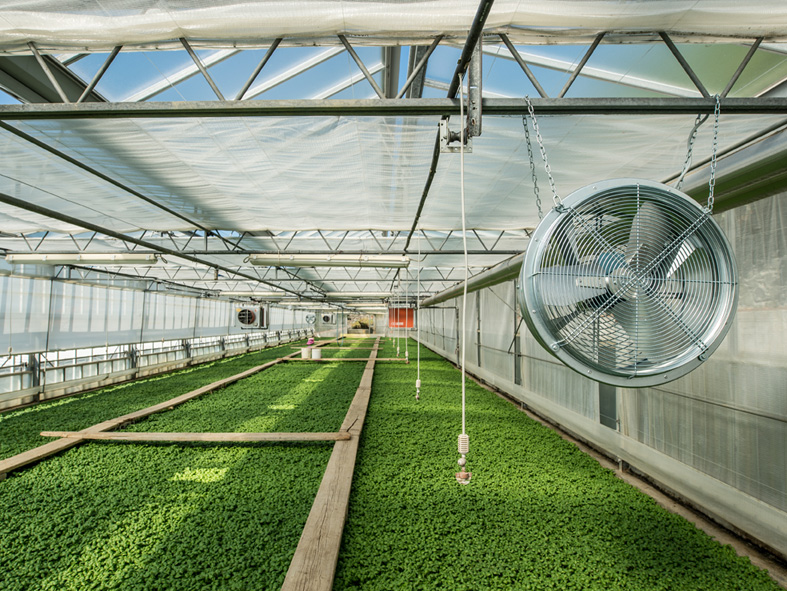
Air stratification, when hot air accumulates at the top of the greenhouse, can lead to uneven temperature distribution, adversely affecting plant morphology, physiology, and reproduction. Implementing an efficient air displacement system minimizes temperature differentials, promoting uniform growth conditions throughout the greenhouse.
Maintaining optimal humidity levels is as critical as temperature control. Excessive humidity fosters fungal diseases like Botrytis and causes condensation issues, leading to water dripping from roofs and walls. Effective air circulation reduces moisture around the plant canopy, creating a drier microclimate that inhibits disease development.
Condensation provides a breeding ground for pathogens. On clear nights, radiant cooling can lower leaf temperatures below ambient air, increasing condensation risk. Proper ventilation mitigates this by maintaining uniform temperatures. Additionally, during daylight, photosynthesis depletes CO₂ near leaf surfaces; air movement replenishes CO₂ levels, sustaining photosynthetic efficiency.
Types of Greenhouse ventilation systems
Greenhouse ventilation systems can be categorized into natural and mechanical types. Natural ventilation relies on wind and thermal buoyancy, utilizing vents and side openings to facilitate air exchange. Mechanical systems, such as exhaust fans and circulation fans, provide controlled airflow regardless of external conditions. Combining both methods often yields the best results, ensuring consistent temperature and humidity control.
Greenhouse ventilation systems: Termotecnica Pericoli’s solution
To address these challenges, Termotecnica Pericoli offers the ACF air circulator, available in 18″, 21″, and 26″ sizes. Built with durable materials, the ACF is engineered for high energy efficiency and versatility. Its narrow outlet cone delivers targeted airflow, cooling crops without disturbing plants or thermal screens. Additionally, the ACF operates at low noise levels, ensuring a comfortable environment for greenhouse workers. Certified by Besslab, the ACF is an ideal solution for maintaining optimal conditions during hot seasons, enhancing both plant productivity and worker well-being.