Greenhouses are artificial environments where it is crucial to maintain the right conditions for plant (or flower) growth in order to achieve high yields and excellent product quality.
One of the key parameters to monitor is greenhouse humidity, but other critical factors include climate control, temperature, and light levels.
We have previously explored the importance of proper air circulation in hot climates. Now we will focus on the challenges related to humidity management, covering topics such as:
- Why is managing greenhouse humidity crucial for plant health?
- Identifying the ideal humidity range.
- The critical relationship between greenhouse temperature and humidity.
- Common problems caused by incorrect humidity and how to prevent them.
- Cooling solutions for maintaining optimal conditions in high-humidity environments.
Why is managing greenhouse humidity crucial for plant health?
It is essential to start by defining Relative Humidity (RH): “the amount of water vapor in the air compared to the maximum the air could hold at a given temperature”.
In a greenhouse environment, this parameter directly influences the key physiological processes in plants, including transpiration, photosynthesis, and nutrient absorption.
When humidity levels are not properly regulated, imbalances may occur that compromise plant development: air that is too dry accelerates transpiration and leads to water stress, while excessive humidity can hinder evaporation, slow growth and encourage the proliferation of pathogens.
Efficiently managing greenhouse humidity not only helps prevent critical issues, but also contribute to optimizing crop yields, and improving product quality by ensuring consistent and optimal growing conditions throughout the entire production cycle.
Identifying the ideal greenhouse humidity range
Humidity is the amount of water vapor present in the air generated by plant evaporation and transpiration.
Humidity levels are commonly expressed as a percentage of Relative Humidity (RH). When RH reaches 100%, the water vapor in the air condenses and forms droplets.
However, condensation can also occur at HR levels below 100% when moist air comes into contact with a surface whose temperature is lower than the dew point. The dew point represents the temperature at which, under constant pressure, moist air condenses into liquid.
In general, the optimal greenhouse crops humidity range is between 50% and 80% of RH, with around 80% RH often cited as a benchmark by industry professionals.
The critical relationship between ideal greenhouse temp and humidity
Ideal greenhouse temperature and relative humidity are closely linked and must be managed together to ensure optimal conditions for plant growth.
A key concept to understand is the air moisture-holding capacity, that is, the amount of water vapor air can retain depending on its temperature: the warmer the air, the greater its ability to hold moisture without condensation. Conversely, as temperatures drop, the air reaches saturation more quickly, raising relative humidity (RH) even if the actual amount of moisture remains unchanged.
This relationship explains why it is important to prevent plant surfaces, such as leaves or fruits, from reaching the dew point, that is, the temperature at which moisture in the air condenses into water droplets.
Condensation directly on crops significantly increases the risk of pathogens development, particularly fungi and molds.
Managing temperature has a direct impact on relative humidity, and vice versa. Heating the air increases its ability to hold moisture, helping to lower RH; cooling, on the other hand, reduces this capacity and increases the risk of condensation.
For this reason, it is essential to monitor and regulate both temperature and humidity simultaneously, taking into account their interdependence. Only a consistence balance between these two factors can ensure a stable, safe, and productive environment for crops throughout all stages of growth.
Common problems caused by incorrect greenhouse humidity and how to avoid them
As we already understood, maintaining humidity within adequate levels is essential to avoid critical issues that can compromise crop yield. When humidity is too high, the damage can affect both the plants and the growing environment.
Below, we analyse the main issues related to an excess of humidity.
Greater incidence of fungi and molds
High levels of humidity facilitate the proliferation of fungal and molds diseases, in particular Botrytis, whose spores spread quickly in the greenhouse closed environment.
Affected plants may show spotting and browning, often early signals of pathogen attack.
To reduce this risk, it is appropriate to intervene with effective ventilation systems and with a precise greenhouse humidity control.
Reduction of photosynthesis due to insufficient evaporation
An excessively humid environment damages the natural evaporation of water from plant leaves, causing a buildup of droplets that can reduce light absorption and, as a result, limit the photosynthesis process.
A well-balanced microclimate, achieved through temperature regulation and the use of dehumidification systems, helps restore optimal conditions for effective photosynthesis.
Reduced light transmission due to condensation
The formation of condensation on greenhouse walls and glazing reduces surface transparency and, as a result, limits the amount of light available for plants. If persistent, this phenomenon can negatively impact plant growth and overall productivity.
Targeted interventions, such as zoned ventilation and surface temperature regulation, can help prevent the buildup of persistent condensation.
Negative impact on the work environment and infrastructures
Excessive humidity promotes dirt accumulation, encourages mold growth on equipment, and accelerates material deterioration. These effects reduce structure efficiency and contribute to an unhealthy work environment.
An integrated climate control system helps maintain sanitary and operational conditions, protecting both crops and personnel.
Cooling solutions for maintaining optimal conditions in high-humidity greenhouses
How to cool a greenhouse in high humidity conditions is one of the most frequent challenges in professional climate management.
Whether in summer or in winter, when heating systems operate at full capacity, maintaining active air circulation remains a best practice.
Several studies have shown that humidity levels above 90% favour the spread of diseases, as well as leaf mold formation and fruits and stems decomposition.
When levels exceed 80%, plant leaves become more vulnerable to pathogens. However, when humidity drops under 70%, the risk of infections and diseases decrease significantly.
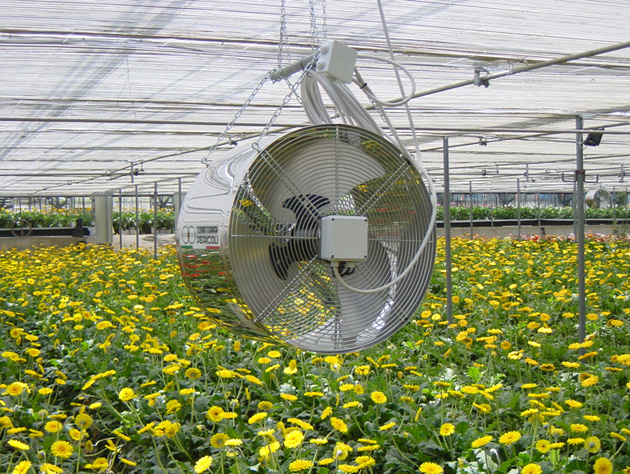
Air circulators installed within the greenhouse help ensure constant airflow, removing excess moisture, drying the environment, and bringing in fresh air enriched with carbon dioxide.
Key features of air circulators units include:
- Small size, to fit into the spaces between crops. (diameters: 18″, 21″, 26″)
- Made of materials that resist even in very aggressive environments
- Air outlet cone specifically designed to be able to cool plants gently without disturbing their heat shield
- Easy to install
- Low noise levels, ensuring optimal working conditions for operators
- Efficiency certifications, ensuring consistent performance even during prolonged use
Keeping air recirculation active, even during colder months, helps prevent moisture buildup, reduce condensation of surfaces and foliage, and minimize the risk of humidity-related diseases.
In high humidity conditions, effective greenhouse cooling depends on the smart integration of temperature and control, tailored to the structure of the greenhouse and the specific crop requirements.