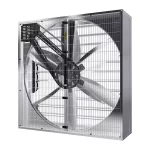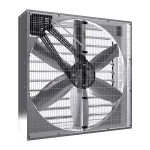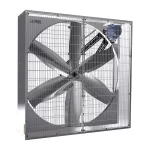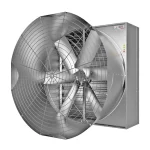

Choosing between a direct-drive and a belt-drive fan is an important decision when designing an industrial ventilation system.
Both technologies offer distinct advantages and understanding their differences and similarities is essential to making an informed choice that maximizes performance, efficiency, and durability.
Understanding the core difference: direct drive vs. belt drive
In a direct-drive fan, the motor shaft is connected directly to the fan blades. There are no intermediate components: the rotation of the motor directly drives the blades, minimizing mechanical losses and allowing for a more compact design.
A belt-drive fan, on the other hand, uses a system of of pulleys and belts to connect the motor to the fan shaft. The motor drives a small pulley which, through the belt, rotates a larger pulley connected to the fan. This configuration makes it possible to adjust fan speed by changing the pulley sizes, without altering the motor speed.
A useful analogy to understand the system is that of a bicycle: the gear and chain mechanism allows you to change the speed and torque by adjusting the gear ratio, just like pulleys and belts allow you to regulate fan speed independently from motor speed.
Key factors compared: efficiency, maintenance, cost, and noise
When comparing these two systems, it is important to consider four key factors:
- Efficiency
Direct-drive fans are more efficient because they eliminate transmission losses associated with belts and pulleys, ensuring that alle motor power is directly transferred to blade movement. However, belt-drive fans remain an efficient solution, as they allow you to optimize the motor’s operating point, keeping it within ideal speed ranges and reducing overall energy consumption. - Maintenance
Direct-drive systems require less maintenance thanks to their simpler design, with no belts or pulleys subject to wear or adjustment. Belt-drive systems, on the other hand, require regular inspections and belt replacements, as they consist of more mechanical parts operating under friction and tension. - Initial cost
Belt-drive fans generally have a lower upfront cost, especially for large diameters. This makes them ideal for budget-conscious projects that still require high airflow capacity with a contained investment. - Noise level
Direct-drive fans are typically as they have fewer moving parts and no belts or pulleys that might cause vibration or mechanical noises. Belt-drive systems, having more moving components, may generate slightly higher noise levels during operation.
| Factor | Direct Drive |
Belt Drive |
| Efficiency | Very high, with no transmission losses | Minor losses due to belt friction |
| Maintenance | Minimal, almost negligible | Requires regular inspections and belt replacements |
| Initial Cost | Higher | Lower |
| Noise Level | Very quiet | May generate vibrations and mechanical noise |
The right fan for your application: agriculture vs. industry
In the end, the best choice depends on the specific application. That’s why Pericoli offers expert consultants to help you identify the ideal solution for your environment.
Livestock Farms
In livestock farms, reliability and low maintenance are essential. In this case, direct-drive fans are the ideal choice: fewer components mean fewer breakdowns and reduced maintenance, minimizing disruptions in sensitive environments like animal housing.
Agriculture (greenhouses, nurseries)
In greenhouses, precise speed control and optimized energy consumption are often critical. Belt-drive fans allow for mechanical adjustments via pulleys, while modern direct-drive fans, combined with electronic control systems, offer the same flexibility with greater efficiency.
Industry
In industrial settings, belt-drive fans remain a reliable choice, especially when high static pressure or large diameters are required with a limited initial investment. They offer excellent scalability, although they may require more frequent maintenance.
Beyond the drive system: the role of modern speed controls (VFDs)
VFDs (Variable Frequency Drives) are devices that regulate the frequency and voltage supplied to the motor, allowing for precise speed control.
This overcomes one of the traditional limitations of direct-drive fans, which were historically considered less flexible.
Combining a direct-drive fan with a VFD means:
- Maximizing energy efficiency;
- Ensuring soft starts that protect the system;
- Achieving highly accurate airflow control.
Pericoli is at the forefront in this field as well, offering integrated solutions that combine robust mechanical engineering with advanced electronic technology.
Why Pericoli is the right choice for your ventilation needs
Choosing Pericoli means relying on a partner that supports you with expertise and reliability, always guaranteeing:
- Quality and durability. Robust materials and Italian design ensure a long-lasting performance.
- Certified performance. Real-world data validated by independent bodies such as BESSlab and our in-house PERIlab.
- Energy efficiency. Every product is engineered to reduce energy consumption and operating costs.
- Technical support. A dedicated team ready to develop the ideal solution for your needs.
- Global presence. With offices and distributors worldwide, we are always by your side.
Pericoli provides ventilation systems, heating, cooling and climate control systems specifically designed for livestock, agriculture, and industrial applications.
Common questions about belt and direct drive fans
Which is better, direct drive or belt drive fan?
It depends on your priorities. If you’re looking for maximum efficiency, minimal maintenance, and low noise, the direct drive is generally the better choice. If you need more mechanical flexibility without advanced electronics, the belt drive remains a valid alternative.
What are the main disadvantages of a belt drive fan?
Belt drive fans have friction losses, require regular inspections and belt replacements, and may produce more noise due to mechanical vibrations.
Are direct drive fans louder than belt drive fans?
No. Direct drive fans are usually quieter because they don’t have belt and pulleys that generate vibrations and mechanical noise.
How does a dusty or humid environment affect the choice?
Dust or humidity can speed up the wear of belts and pulleys, making direct drive a more reliable long-term solution. The simpler structure of direct drive systems also makes it easier to protect against external agents.