The challenge: managing heat stress in modern dairy barns
In high-producing dairy cattle farms, heat stress is one of the main threats to animal welfare and productivity.
These animals have a relatively narrow “thermoneutral zone”, typically between 5°C and 20°C, beyond which they begin to show signs of discomfort. When the Temperature Humidity Index (THI) exceeds critical values, cows:
- Reduce feed intake;
- Produce less milk;
- Become more vulnerable to diseases such as mastitis.
Global warming and the increasing frequency of heat waves have made traditional solutions such as natural ventilation increasingly effective. Stagnant air inside modern barns, often enclosed or insulated for hygiene or climate control reasons, does not allow sufficient air exchange to maintain ideal conditions.
For this reason, more progressive farmers are adopting active mechanical ventilation systems capable of precisely controlling temperature, humidity, and air movement.
In this context, the use of advanced solutions such as fans for dairy cattle represents an effective way to structurally address the problem of summer heat stress.
What is a cross-ventilation system? The core components
A cross-ventilation system is an advanced technological solution designed to improve indoor air quality in livestock barns by using mechanically driven airflow that moves horizontally across the entire width of the building, from one side to the other.
This principle enables constant and controlled air exchange, reducing indoor temperature, humidity, and the concentration of harmful gases.
The core of the system consists of several key components, each serving a specific function:
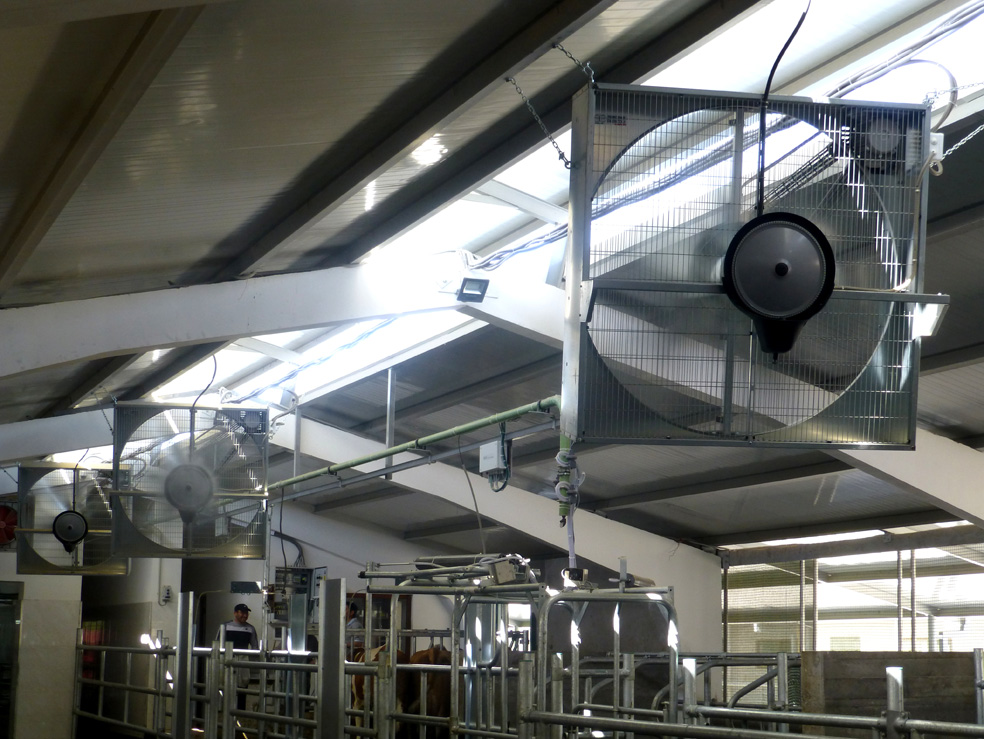
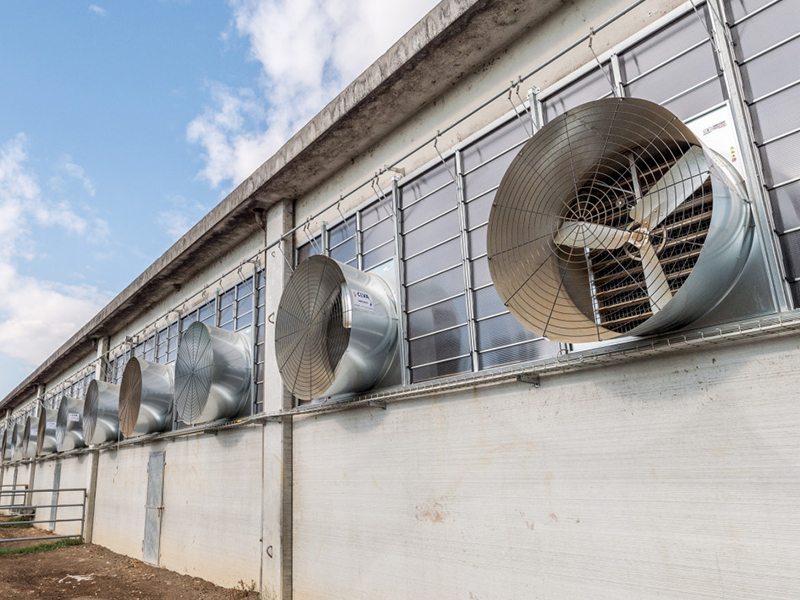
- Exhaust Fans: the “engine” of the system. Installed on one side wall of the barn, they extract large volumes of air and create negative pressure that draws fresh air inside.
- Air Inlets: located on the opposite wall from the fans, they regulate the controlled entry of fresh air, ensuring uniform airflow distribution.
- Evaporative cooling pads: panels installed at the air inlets that cool incoming air through water evaporation. This combination of ventilation and adiabatic cooling is particularly effective during the hottest periods.
- Baffles: installed inside the barn, they direct airflow downward toward animal level. This concentrates the cooling effect where it is most needed, improving cow comfort and productivity.
The solution in action: the “La Torre” farm project
“La Torre” is a family-owned farm located near Turin, hosting approximately 360 Italian Friesian dairy cows. Mr. Mario San Martino runs the business together with his sons, combining tradition and innovation.
For this farm, a cross-ventilation system integrating mechanical ventilation and evaporative cooling was designed and installed, providing a complete climate control solution for dairy barns.
The project was developed through a collaboration between the Pericoli Group and Civa Impianti.
Technical features of the project and integrated solutions:
- Barn structure: 70x42m
- Exhaust fans: 21 cone fans EOC53s
- Gutter frame system: 70x3m MFX
- Evaporative panel: PERIcool 1545/7 with anti-algae treatment
The results: improved productivity and animal welfare
The results achieved through the implementation of the cross-ventilation system at the “La Torre” farm were immediate and significant.
Farmers recorded lower energy costs and improved overall farm efficiency.
From a production standpoint, there was a 10% increase in both milk production and dry feed intake, along with a drastic reduction in mastitis cases (-50%) and lameness.
Additional benefits included a reduction in insect presence during the hot season, increased fertility and birth rates, overall improvement in animal welfare, and greater cow vitality. This also resulted in more intensive use of feeding areas (bunks).
“In addition to the positive results about animal welfare and milk production increase, we recorded great savings related to electricity costs. We are very satisfied with the investment: for us it was an interesting and stimulating challenge, but above all, in few months we’re already gathering interesting and promising results for the future. The savings that we can achieve using this system, in terms of energy consumption and efficiency, allow us to pay back the investment costs in a very short time and this is definitely an added value to the positive results already explained” – Mario San Martino (owner).
Key considerations for designing your own system
Before designing a cross-ventilation system for your barn, it is essential to consider several technical and structural aspects that can influence system performance. The main ones include:
- Building orientation: properly aligning the building with prevailing winds helps optimize airflow direction and reduces the workload required from the fans to ensure uniform ventilation.
- Sizing the System: it is crucial to accurately calculate the required air changes per hour and the CFM (cubic feet per minute) per animal in order to correctly size fans and the other components based on herd size and building dimensions.
- Comparing with Tunnel Ventilation: tunnel ventilation is a valid alternative when the barn is particularly long and narrow. The choice between tunnel and cross-ventilation depends on the building’s shape, width, and layout.
- Maintenance: regular maintenance of fans, cooling pads, and automated control systems is essential to maintain high performance over time, prevent efficiency losses, and extend system lifespan.
Frequently asked questions
What is the difference between cross ventilation and tunnel ventilation?
Cross-ventilation moves air horizontally from one side of the building to the other, while tunnel ventilation channels airflow in a straight line from one end of the barn to the other. The choice between the two systems depends on the building’s shape and size.
How many air changes per hour are needed in a dairy barn?
In dairy barns, during hot periods, an average of 40 to 60 air changes per hour are typically required to ensure optimal animal welfare conditions.
Are cross ventilation systems suitable for poultry or swine?
Yes, cross-ventilation systems can also be adapted for poultry and swine farms, with appropriate design modifications to meet the specific needs of each species.
How do cooling pads work with a cross-ventilation system?
Cooling pads cool incoming air through water evaporation. Warm air passes through the wet panels, cools down, and is then distributed inside the barn through the ventilation system, helping maintain comfortable temperatures for animals.