
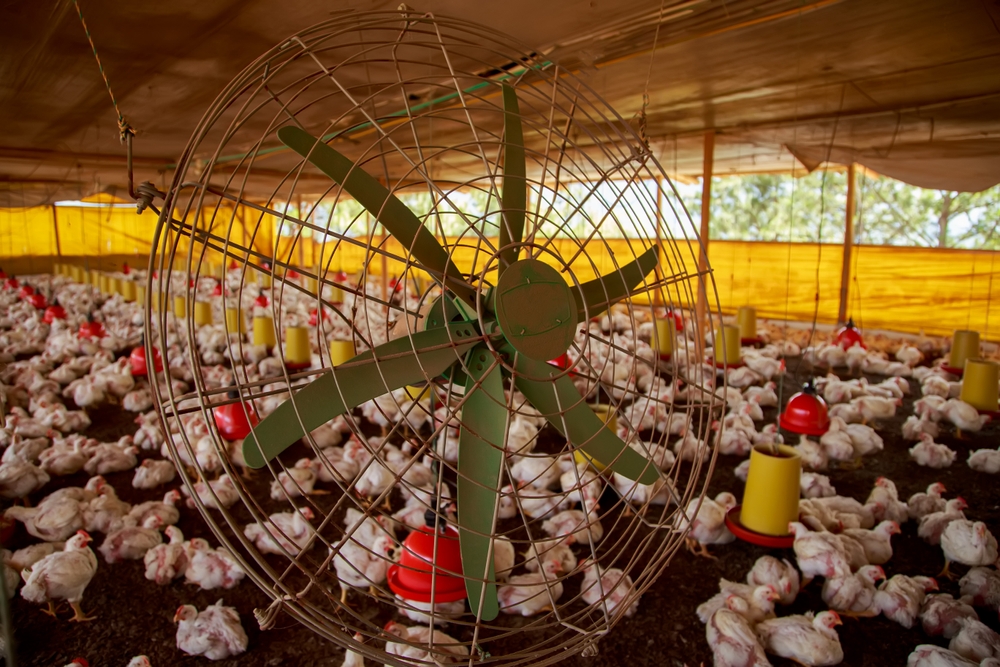
What is an air blaster in agricultural ventilation
In a purely industrial or engineering sense, an air blaster is a pneumatic device designed for de-clogging heavy materials. It satisfies the need for high-force impact in bulk storage.
However, within the livestock sector, an “air blaster” refers to high-speed circulation fans designed to project a concentrated, high-velocity stream of air over long distances.
While traditional fans provide general air exchange, the air blaster series is engineered to “blast” air specifically where it is needed most. This guide focuses on these high-performance circulation systems, which are essential for maintaining stable temperatures in large-scale farming environments.
Designing blaster air systems for heat stress relief
High-speed ventilation is the primary defense against heat stress in intensive farming, particularly for poultry, bovine, and swine livestock.
When temperatures rise, animals struggle to dissipate metabolic heat, leading to reduced productivity or even mortality. By implementing targeted high-speed circulation, farm managers can achieve:
- Effective thermal abatement: Rapid air movement increases the rate of convective cooling on the animal’s skin.
- Precise humidity control: High-velocity streams prevent the buildup of stagnant, moist air pockets that exacerbate heat perception.
- Elimination of heat traps: Uniform air distribution ensures that every corner of the facility remains within the optimal biological window.
These systems are designed to maximize energy efficiency by delivering high airflow volumes without the excessive power consumption typical of older, less aerodynamic models.
Technical specifications of the air blaster series
The engineering behind an agricultural air blaster focuses on durability and sustained performance in harsh environments. Unlike standard commercial fans, these units are built to withstand the corrosive atmosphere of livestock houses, which often contain high levels of ammonia and dust.
Key technical characteristics include:
- High-grade materials: Use of corrosion-resistant alloys and treated plastics for long-term structural integrity.
- Aerodynamic shrouds: Specially designed casings that concentrate the airflow into a tight, powerful “jet” to extend the throw distance.
- Certified performance: For instance, at Termotecnica Pericoli, all units undergo rigorous testing in the PERIlab laboratory to verify energy consumption, noise levels, and actual airflow delivery.
This scientific approach ensures that the mechanical output matches the theoretical design requirements of the HVAC project.
Strategic fan placement for maximum airflow distance
For HVAC consultants and installers, the effectiveness of an air blaster depends entirely on its positioning. Incorrect placement creates “dead zones” where air remains stagnant, leading to localized heat spikes and poor animal welfare.
To optimize the installation, follow 3 technical principles:
- Overlap the airflow: Position fans so that the “throw” of one unit reaches the intake area of the next, maintaining a constant air speed throughout the building.
- Avoid obstructions: Ensure the trajectory is clear of structural beams or internal equipment that could break the laminar flow and reduce distance.
- Angle adjustment: Fine-tune the downward tilt to ensure the high-speed air reaches the animal level directly.
Strategic placement maximizes the ROI by reducing the total number of units required to achieve the desired cooling effect: for example, a well-planned layout in a 100-metre barn can lower operational costs by up to 20% compared to a haphazard installation.
Improving animal comfort with targeted high-speed circulation
The ultimate goal of high-speed air circulation is to enhance the biological performance of the livestock. In poultry and swine farming, targeted airflow assists in the rapid removal of harmful gases such as ammonia and CO2, which tend to settle at the floor level.
For instance, in a high-density broiler house, maintaining a consistent air speed of 2.5 to 3.0 m/s across the birds can prevent wet litter issues and respiratory distress. When animals are comfortable, they maintain better feed conversion ratios, directly translating into higher profitability for medium and large agricultural enterprises.
Termotecnica Pericoli: Made in Italy climate control solutions
With over 50 years of experience, Termotecnica Pericoli is a global leader in the design and manufacture of climate control systems. Our commitment to innovation, ethics, and “Made in Italy” quality ensures that every air blaster and circulation fan meets the highest international standards.
We provide comprehensive solutions, for instance related to heating systems for agriculture and farms and cooling systems for agriculture and farms: tthrough our global network and advanced R&D, we help producers worldwide achieve an eco-sustainable climate for both their livestock and their personnel.
FAQs on livestock air blasters
What is an air blaster used for?
In a broad sense, an air blaster is used for industrial de-clogging in silos using compressed air. In agricultural and livestock sector, it refers to specialised high-speed fans used to provide targeted cooling and air circulation in livestock and greenhouse environments.
What is air blasting?
It is important to distinguish between air blasting (the release of air to move materials or cool animals) and abrasive blasting (often called sandblasting), which is a surface-cleaning technique using high-pressure air mixed with abrasive media.
What is an air blaster gun/toy?
The term “air blaster” is also commonly used for small handheld cleaning tools or children’s toys that shoot compressed air or foam projectiles. These are consumer-grade items and are entirely unrelated to the professional-grade agricultural ventilation systems discussed here.
How is an air blaster controlled?
Modern agricultural air blasters are typically integrated into a central climate controller. They can be managed via remote control systems or automated sensors that adjust fan speed based on real-time temperature and humidity data, ensuring optimal conditions 24/7.